


Key Takeaways
Saylor said the SEC’s Sept. 17 exemption enables 24/7 onchain trading of tokenized MSTR and STRC.Strategy holds 845,050 BTC and $6.4 billion in USD assets, with STRC still under its $100 par.The SEC capped symbols and volume per venue, and the relief expires five years after publication.
A Reaction, Not a Rule
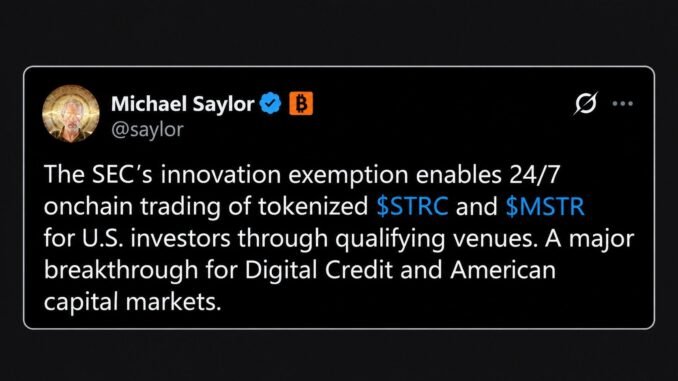
Saylor did not wait long to make the proclamation and hours after the SEC published its relief yesterday, the Strategy chairman wrote on X that it “enables 24/7 onchain trading of tokenized” MSTR and STRC “for U.S. investors through qualifying venues,” calling it “a major breakthrough for Digital Credit and American capital markets.”
The SEC granted five-year relief allowing tokenized National Market System (NMS) stocks to trade on venues built around automated market makers (AMMs) and liquidity pools, without those venues registering as exchanges. Tokens must be backed one-to-one by the underlying share and carry the same rights, i.e., votes, dividends and proxies. Synthetic exposure is not covered.
SEC Chair Paul Atkins said of the measure:
[It] is designed to resolve challenges that have prevented responsible innovation from taking root in the United States while providing investor protections and market integrity standards.
Commissioner Mark Uyeda postured the development as a chance to experiment responsibly, learn, and translate old protections to new contexts. The agency said the move would help bring the country’s capital markets into the digital age.

Why Strategy Cares More Than Most
For most issuers, onchain equity trading might be considered a mere curiosity, but for Strategy it is a distribution problem being solved.
This is because STRC is a variable-rate perpetual preferred share collateralized by the company’s bitcoin and dollar reserves, and Saylor has called it the world’s largest preferred stock less than a year after launch. He has also spent months arguing that private credit is illiquid, opaque and fee-laden, while digital credit is liquid, transparent and cheap, a case he carried to Goldman Sachs when the firm’s bitcoin-backed lending book passed $11 billion.
Continuous trading is the part of that argument he could not previously deliver. A preferred share that stops trading at 4 p.m. Eastern time and sleeps through weekends is still a traditional security wearing a new name. Under the exemption, a qualifying venue could quote it whenever the buyer shows up.
The timing, however, is awkward in one respect, given Strategy’s own war chest has been busy defending the instrument rather than adding to its bitcoin pile, with the firm most recently repurchasing $139 million of STRC between Sept. 8 and Sept. 13 while buying no BTC at all.
Not only that, STRC has been trading below its $100 par, which is precisely the condition Saylor needs to fix, and broader access could be one way to do that.
Bitcoin’s price is the other variable he does not control. BTC touched $77,000 yesterday after the Federal Open Market Committee (FOMC) raised rates by 25 basis points, a move that forced roughly $260 million in short liquidations.
Saylor’s own thought process this year has leaned on the gap between the two, noting that bitcoin fell 47% over a stretch in which STRC gained 9%.


Be the first to comment